AI is entering a new phase and remains a major structural theme for equity markets in 2026. As 2027 approaches, a wide range of research reports* and surveys indicate that AI investment is entering a new phase, and investors’ attention is broadening from infrastructure spending to end-user adoption and earnings delivery.
AI applications extending beyond conversational chatbots
One key development in 2026 has been the emergence of AI agents that can carry out multi-step workflows for the mass market.
AI agents have seen strong demand from end users since they become part of mainstream AI products in 2026. For example, Sensor Tower estimates that Meta Muse (Meta platform’s personal AI agent, launched on 8 September 2026) recorded more than 83,000 downloads in its first two days and more than 10 million downloads in its first 40 days.
This illustrates the shift towards more action-oriented applications, expanding both the range of use cases and the computing resources required for each task, which may in turn drive higher demand on AI infrastructure.
Recent AI industry developments leading to higher CPU demand
The evolving requirements of AI agents are broadening demand across the AI value chain, extending beyond GPUs to CPUs, memory and software applications.
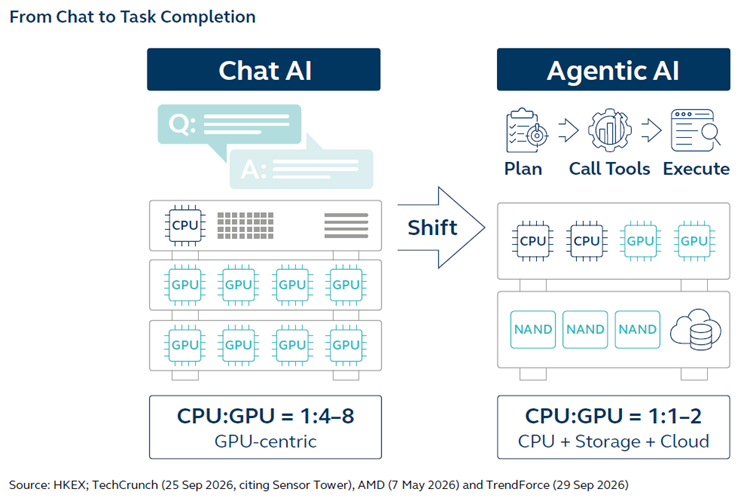
Compared with conversational chatbots, AI agents require more model calls, CPU-based orchestration and data access to execute multi-step workflows. These requirements, in turn, increase demand for CPU computing capacity.
These additional CPU requirements are reflected in the changing balance of CPU and GPU capacity in agentic systems, even as GPUs remain central to AI training.
For instance, semiconductor company AMD noted in mid-2026 that agent workflows require a separate CPU compute layer alongside GPU infrastructure, with configurations shifting from roughly one CPU per four to eight GPUs in chatbot deployments towards one CPU per GPU in some agentic systems.
Similarly, industry research provider TrendForce, projects a CPU-to-GPU ratio of around 1:1-1:2, pointing to a greater role for CPUs relative to GPUs in agentic systems.
Domestic AI applications and compute accelerate
China’s AI ecosystem is also shifting towards task-executing AI agents, with major technology platforms developing consumer and enterprise applications alongside the supporting computing infrastructure. Examples of developments in China during 2026 include:
Agent models and applications
- ByteDance (private) released Seed1.8, a general-purpose agent model that the company describes as supporting information retrieval, code generation, graphical user interface interaction and complex workflows;
- Tencent Cloud (700 HK) launched LightVela, a cloud-hosted personal AI agent platform based on Hermes Agent, with features including persistent memory, task automation and integration with messaging applications;
- Alibaba Group (9988 HK) reported more than 30 million users of its workplace AI agent platform, QwenWork, within one month of its public beta launch.
Computing infrastructure
- Alibaba Group (9988 HK) announced the Zhenwu V900 AI chip, with mass production and commercial release planned for Q1 2027;
- Huawei (private) introduced the Atlas 960E SuperPoD, which the company states can scale to 4,096 NPUs and provide 8 EFLOPS of computing performance at FP8 precision; and
- JD (9618 HK) announced plans for a 100,000-GPU computing cluster using Moore Threads chips to support large-model training, inference and embodied AI.
China's AI ecosystem: Domestic token demand increase
Beyond product launches and infrastructure investment, model usage provides another perspective on China’s AI ecosystem.
An October report released by the China Academy of Information Communications Technology put daily token consumption in Mainland China at approximately 500 trillion in June 2026, nearly four times the December 2025 level.
With agents relying on repeated model calls to complete multi-step tasks, token usage offers a useful metric to measure demand on AI models underlying these applications.
China’s large-scale digital use cases, including e-commerce, food delivery and mobility, support the end-user demand underlying agent-driven token consumption.
These offer practical settings for agents to execute tasks, while rapid product iteration and proprietary data support their deployment and commercialisation.
Hong Kong-listed stocks in the AI value chain
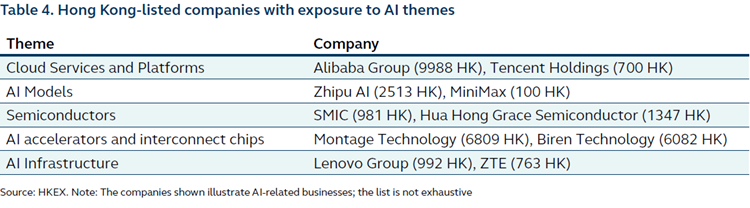
In Hong Kong, the AI theme spans several parts of the value chain, including cloud platforms, AI model developers and hardware.
The companies below illustrate the range of businesses connected to these areas. Relevant reported measures include cloud revenue, infrastructure utilisation and hardware orders.
- Cloud services and platforms: Alibaba (9988 HK) and Tencent (700 HK) are illustrative of this segment, given their established cloud businesses and investments in AI-related infrastructure, including proprietary chips and computing clusters.
- AI models: In this part of the market, Zhipu (2513 HK) AI and MiniMax (100 HK) provide two Hong Kong-listed examples of developers serving consumer and enterprise AI applications.
- Domestic compute and hardware: This part of the value chain includes foundries such as SMIC (981 HK) and Hua Hong Grace Semiconductor (1347 HK), memory-interface and high-speed interconnect specialist Montage Technology (6809 HK) and AI accelerator developer Biren Technology (6082 HK), and system suppliers such as Lenovo (992 HK) and ZTE (763 HK). Together, they illustrate the breadth of businesses involved in domestic compute upgrades and data-centre build-out.
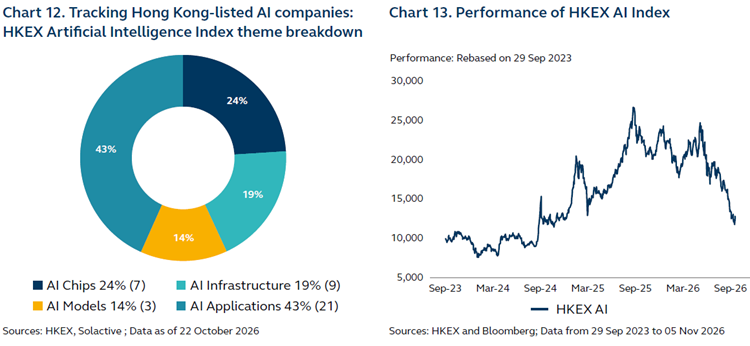
Alongside company-level developments, the HKEX Artificial Intelligence Index tracks the equity performance of Hong Kong-listed companies across the AI value chain. The index comprises 40 companies spanning AI chips, AI infrastructure, AI models and AI applications.
The index’s composition also illustrates how Hong Kong’s AI exposure extends beyond cloud platforms and model developers.
As of 22 October 2026, AI applications accounted for 43.3% of index weight, followed by AI chips at 24.0%, infrastructure at 19.1% and models at 13.6%.
Its largest constituents included SMIC, Hua Hong Grace, Lenovo, SenseTime and MiniMax. (see Chart 12 for AI theme breakdown)
AI model developers are seeking capital to fund model development and expand computing capacity as they scale. Anthropic announced plans for an IPO on 26 October, while media reports suggest that more AI model companies could pursue listings in 2027. These developments highlight the role of public markets in financing the sector’s expansion.
AI companies’ ability to generate earnings is a central consideration for investors.
Recent results announcements by technology companies highlight investor scrutiny of AI spending and financial performance.
For instance, Alphabet fell about 10% in after-hours trading on 28 October after revenue and earnings missed expectations and free cash flow turned negative, while Oracle rose around 11% that day as its long-term revenue targets and financing plans eased concerns over AI infrastructure spending.
Hong Kong-listed companies’ results also diverged: Montage Technology closed 2.2% higher on 2 November following strong nine-month results, while Victory Giant Technology closed 9.5% lower on 30 October after reporting a 52% decline in third-quarter net profit, mainly driven by non-recurring losses.
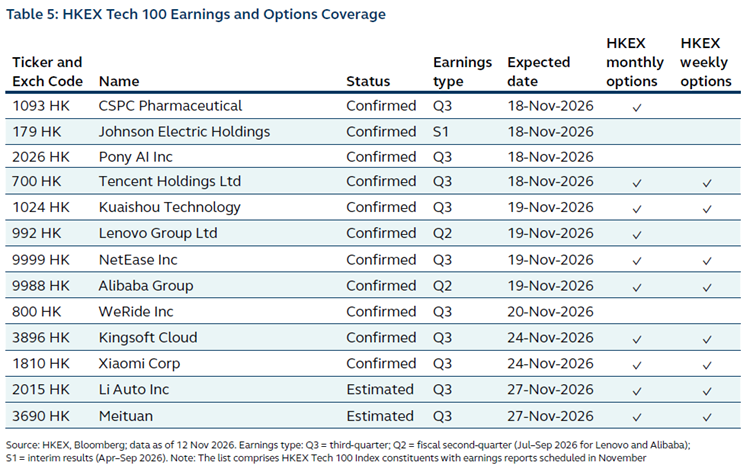
Table 5 sets out the constituents of HKEX Tech 100 Index that are expected to announce earnings in November, and indicates the availability of HKEX-listed monthly and weekly stock options.
![]() Discover more about Hong Kong’s evolving AI ecosystem:
AI IPOs Drive a Strong Start to 2026 >
AI IPOs Create a New Issuer Ecosystem >
ECM Series: Hong Kong’s Follow-on Market Momentum >
* Stanford Institute for Human-Centered Artificial Intelligence, AI Index Report 2026: Economy, 2026